Specific Conductance & Chloride Concentrations
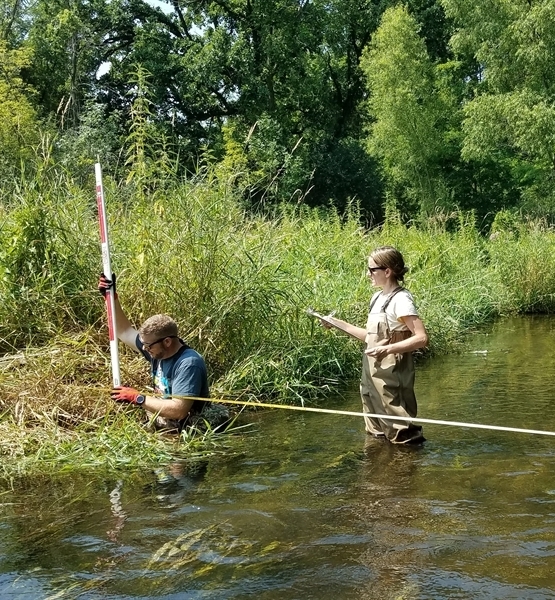
Previous studies have demonstrated that specific conductance is a sound predictor of chloride concentration once a reliable relationship is established. Specific conductance measurements, collected at 5-minute intervals at each monitoring site, were paired with the corresponding chloride concentration obtained from grab samples and used to develop regression relationships. Thirty of the 41 stream monitoring sites fit a “piecewise regression model”, which may be used for estimating average concentrations of chloride from future specific conductance monitoring efforts in the Region. See Technical Report No. 64 (TR-64) for more details on developing the regression models for the Region.
Chloride Trends in Southeastern Wisconsin
Staff conducted a comprehensive analysis of historical and current chloride conditions and trends in the Region’s streams, lakes, and groundwater, integrating data from the Chloride Impact Study, government agencies, universities, nonprofits, and citizen groups. Nearly ninety percent of the lakes in the Region with sufficient data have significantly increasing chloride concentrations over time. A large portion of chloride samples from streams and lakes in the Region exceeded thresholds associated with negative biological impacts or established guidelines and regulatory thresholds from agencies outside of Wisconsin. While stream chloride levels increased significantly over the full period of record (1962-2022), recent period data (2013-2022) suggests that trends at some locations may be plateauing or even decreasing. Chloride concentrations are also increasing in shallow groundwater wells across the Region, with over half the chloride samples exceeding natural concentrations and approximately nine percent exceeding enforcement standards. Municipal drinking water supply wells, particularly wells shallower than 300 feet deep, are also experiencing increasing chloride concentrations.
Sources of Chloride in Southeastern Wisconsin
Commission staff evaluated sources of chloride to the environment within the Region during the study period from October 2018 through October 2020. A Regional chloride budget was developed to estimate the average annual chloride contribution, or chloride load, from various sources. The eight sources considered for the Regional chloride budget contributed over 460,000 tons of chloride to the environment per year on average. Winter maintenance, including public and private deicing activities, had the highest chloride contribution and accounted for approximately 59 percent of the annual chloride load in the Region. The second highest chloride contribution was from wastewater effluent, which included public wastewater treatment facilities, industrial facilities, and residential septic systems, and comprised a combined 36 percent of the annual chloride load. Agricultural sources of chloride, such as potash fertilizer, livestock manure, and irrigation, accounted for about 5 percent of the annual chloride load in the Region. Atmospheric deposition was the only natural source of chloride quantified for the analysis and made up slightly more than 0.1 percent of the total annual chloride load in the Region.
Technical Reports
A series of seven technical reports will be prepared for the Study. The completed technical reports include documentation of the field monitoring effort (TR-61), a literature review of the impacts of chloride to the natural and built environment (TR-62), documentation of the regression evaluation for specific conductance and chloride (TR-64), a mass balance analysis of chloride sources in the Region (TR-65), and legal and policy considerations for chloride management (TR-67). Two technical reports are currently being finalized, including an analysis of chloride conditions and trends in our streams and lakes (TR-63) and a review of state-of-the-art practices and technologies for chloride management (TR-66).
Commission staff are currently developing a capstone planning report that will summarize the information in the technical reports and consider potential future conditions and alternative scenarios. Draft chapters for the in-progress technical reports and planning report will be posted on this page for review and comment as they are completed.